
A chandelier can establish the hierarchy of an entire room before a single piece of furniture is noticed. For that reason, statement chandelier selection is not simply a question of finding an expressive silhouette. It is an exercise in proportion, atmosphere, architectural context and the way a home is actually lived in. The most successful schemes make the fitting feel inevitable: generous in scale, purposeful in placement and quietly in dialogue with everything beneath it.
Begin with the room’s architecture
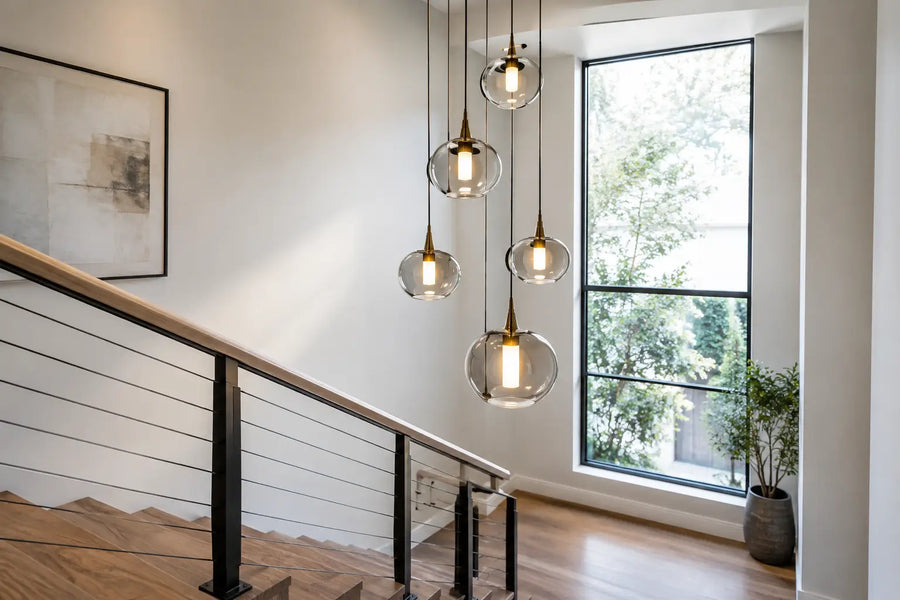
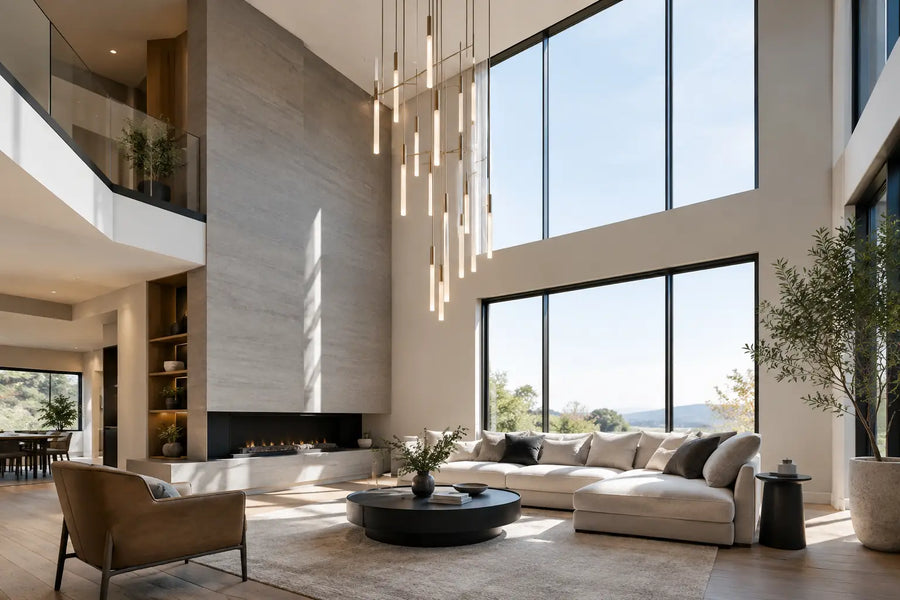
A statement chandelier should respond to volume, not just floor area. Ceiling height, cornice depth, ceiling coffers, window positions and the sightlines from adjoining rooms all influence the right choice. In a double-height entrance hall, the fitting is often read from both below and across a landing, so its profile and underside deserve as much consideration as its overall diameter. A wide, low-ceilinged drawing room may call for a horizontally composed design that gives presence without compressing the space.
The architectural language of the room should also guide the piece. A sculptural contemporary chandelier can bring a welcome tension to a period property, but it needs a clear reason for being there. Its finish, line and visual weight should relate to the joinery, metalwork or furniture rather than appearing as an isolated gesture. Equally, a traditional crystal form can feel unexpectedly current in a restrained modern interior when the scale is confident and the surrounding palette is disciplined.
Before considering a model, establish the chandelier's visual territory. In a dining room, this is usually defined by the table. In an entrance, it may be the central axis of the stair or the geometry of the floor below. In a living room, a decorative ceiling fitting should relate to the seating composition, not necessarily the exact centre of the ceiling. These distinctions are subtle, yet they prevent a room from feeling mechanically arranged.
Scale is a matter of proportion, not formula
There are useful starting points for chandelier dimensions, but a formula cannot account for the visual density of a design. A spare arrangement of slim bronze arms may occupy a substantial diameter while retaining an airy character. A compact chandelier in alabaster, hand-blown glass or layered crystal can appear materially dense and may need more breathing room around it.
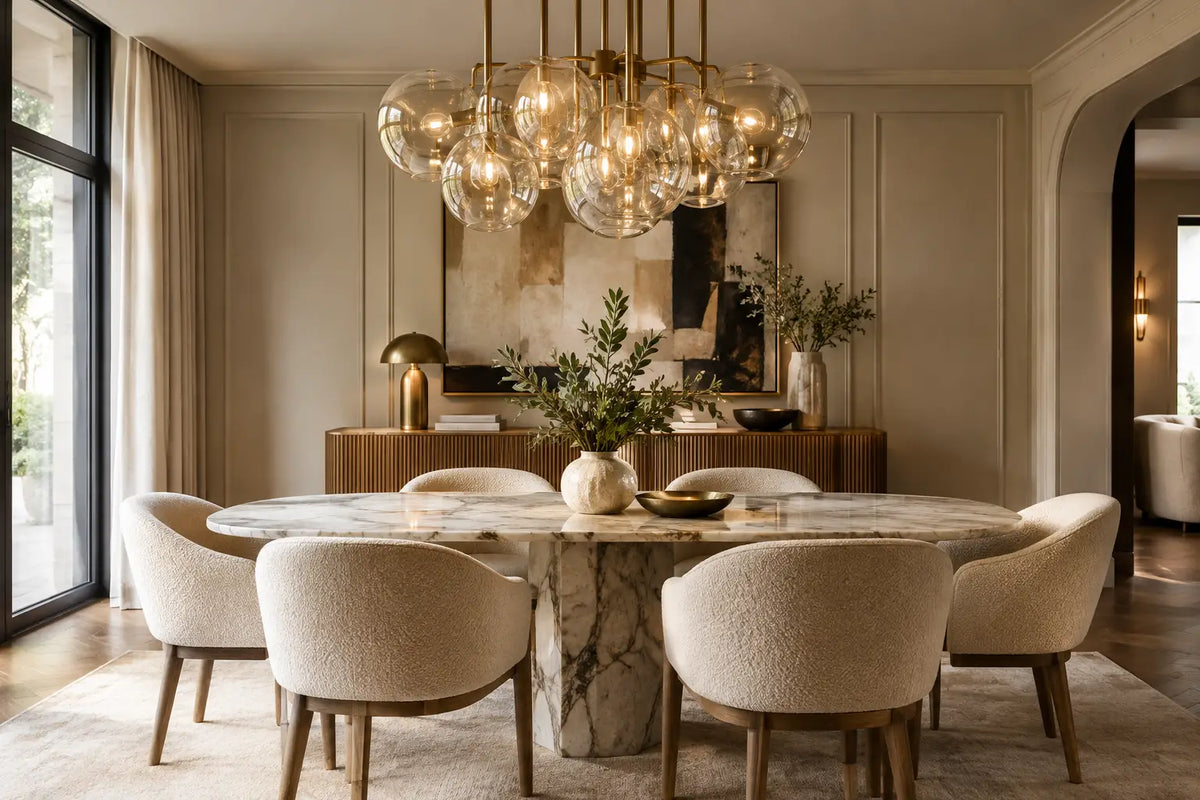
For a dining table, a chandelier should generally sit within the table’s perimeter rather than extending beyond it. A long table often benefits from a linear composition, a series of pendants, or two related fittings positioned along its length. One central chandelier can still work beautifully, particularly above a round or square table, provided its diameter has sufficient authority to anchor the arrangement.
Height is just as important. Above a dining table, the lower edge commonly sits around 75 to 90 centimetres above the surface, adjusted for ceiling height, chandelier volume and the seated sightline. The aim is intimacy without interruption: guests should see one another without looking through an excessive cluster of decorative elements. In circulation areas, maintain generous clearance beneath the fitting. Where ceilings are particularly high, simply raising a small chandelier is rarely convincing. A larger form, a longer suspension or a composition with greater vertical presence is usually required.
Do not confuse size with impact. A chandelier with considered negative space, exceptional material and a strong silhouette can command a room without overwhelming it. Conversely, an oversized fitting with no relationship to the architecture can make even a generous interior feel unsettled.
Statement chandelier selection and the quality of light
A chandelier must perform after daylight fades. Decorative lighting is often selected for its daytime appearance, but evening illumination reveals its true character. Ask what the fitting contributes to the room: soft ambient glow, sparkle, downward task light, reflected warmth or a sculptural presence that remains legible when dimmed.
Exposed bulbs can create a beautiful rhythm, though they require careful specification. Their brightness, colour temperature and visibility from a seated position all matter. In formal entertaining spaces, warm light generally supports richer finishes and more flattering complexions. Lamps with a high colour-rendering quality will also show timber, stone, artwork and upholstery with greater fidelity.
Dimming should be considered at the outset, not added as an afterthought. The compatibility between lamps, drivers and control systems needs to be checked carefully, particularly for integrated LED chandeliers. A refined lighting scheme rarely relies on a chandelier alone. Table lamps, wall lights, concealed architectural lighting and occasional floor lamps provide the layers that allow a room to shift from practical daytime use to a more intimate evening setting.
In kitchens and breakfast rooms, consider how decorative lighting works alongside task illumination. A large chandelier may be appropriate above a dining zone, but it is seldom the sole answer over a hardworking island. The fitting should never cast unwanted shadows across preparation surfaces or compete with the practical lighting needed nearby.
Material should reward close attention
At this level, material is not a finishing detail. It determines how a chandelier catches light, ages and holds its presence in the room. Hand-blown glass brings variation and softness; its slight irregularity is part of its appeal. Alabaster offers a diffused, almost architectural glow, but its natural veining means every element will differ. Fine metalwork introduces crispness and structure, with patinated bronze, brushed brass and darkened nickel each producing a distinct mood.
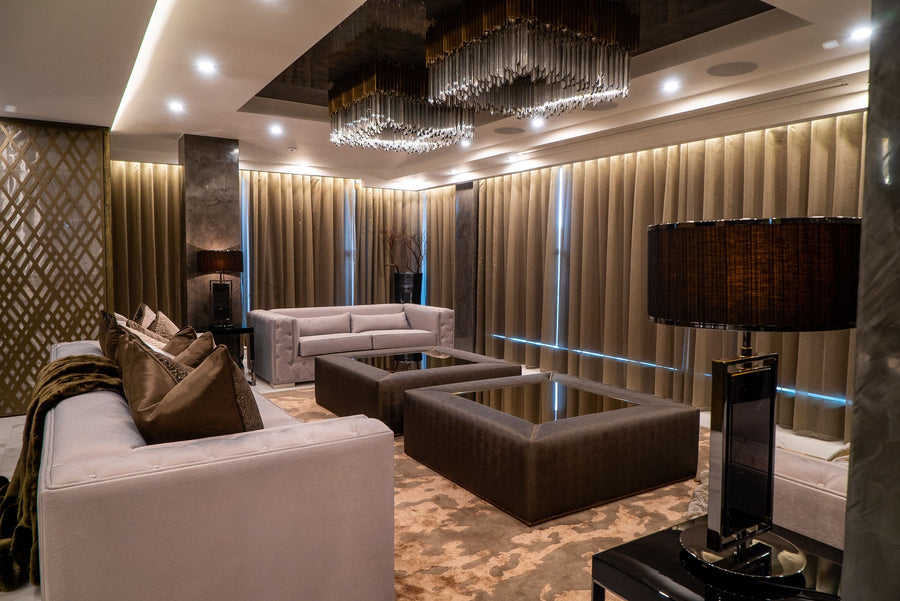
Crystal deserves a more nuanced reading than its traditional associations suggest. Precision-cut crystal can provide clarity and brilliance, while hand-worked or smoked versions bring depth and restraint. Its success depends on lighting control and context. In a room already rich in reflective surfaces, a heavily faceted piece may become visually busy. Against limewash, timber panelling or honed stone, it can supply a measured note of luminosity.
Consider maintenance before committing to complex forms. Open glass elements may be relatively straightforward to dust, while densely layered designs require specialist cleaning and safe access. This is especially relevant in stairwells and vaulted rooms, where the practicalities of future care should inform the selection as much as the first impression.
Resolve the technical details early
The most beautiful chandelier is compromised if its installation appears improvised. Ceiling roses, suspension points, cable routes and mounting plates should be coordinated before finishes are complete. Larger fittings may require structural support beyond a standard electrical ceiling point, particularly in older properties or where ceilings have been lowered.
Weight, access and servicing should be reviewed with the electrical and design teams. In a new-build residence, this coordination can be integrated into the reflected ceiling plan. In a renovation, it may involve opening up part of the ceiling to create appropriate support or conceal wiring. Such preparation is not glamorous, but it protects the final effect.
Suspension details deserve equal attention. Chain, stem, cable and fine wire each create a different visual language. A chandelier hung on a chain may suit a more classic interior, while a precise stem can reinforce a contemporary architectural scheme. The drop should be established on site wherever possible, using the actual furniture layout and ceiling conditions rather than relying solely on a drawing.
Choose presence that will endure
A statement chandelier need not repeat every finish in the room. In fact, exact matching can make an interior feel over-coordinated. Better results often come from a considered relationship: a bronze fitting that echoes the warmth of walnut, a pale alabaster form that speaks to limestone, or dark metalwork that gives definition to a softly layered scheme.
The most enduring choices have a point of view but avoid novelty for its own sake. They are grounded in strong geometry, accomplished craftsmanship and materials that improve with familiarity. In projects undertaken by Touched Interiors, lighting is considered alongside spatial planning, furniture proportions and material palettes because these decisions are inseparable in a composed home.
When assessing a final option, imagine the fitting at several moments: viewed from the threshold, during a quiet breakfast, over a formal dinner and in the low light of late evening. The right chandelier will not demand attention at every moment. It will give the room a centre of gravity, then allow the life within it to take precedence.
Touched Interiors
The Insider is written by the Touched Interiors design studio in Manchester, founded by Kunal Trehan in 2009 and named Interior Design Studio of the Year in 2024 and 2025. About the studio.