


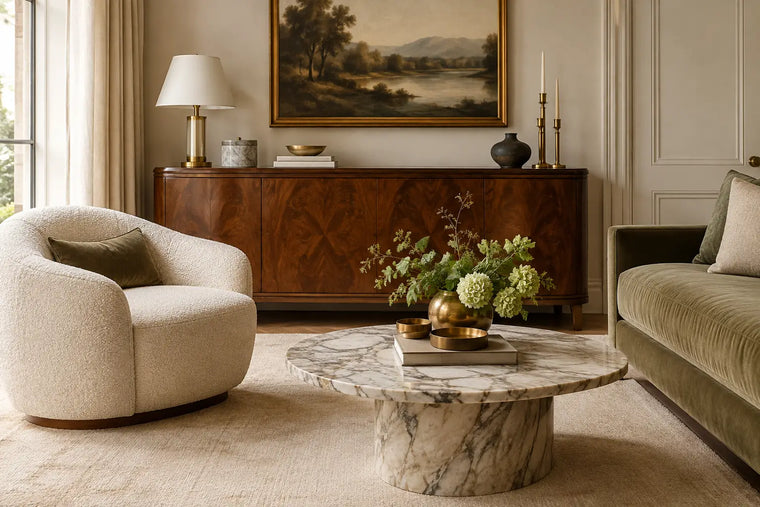

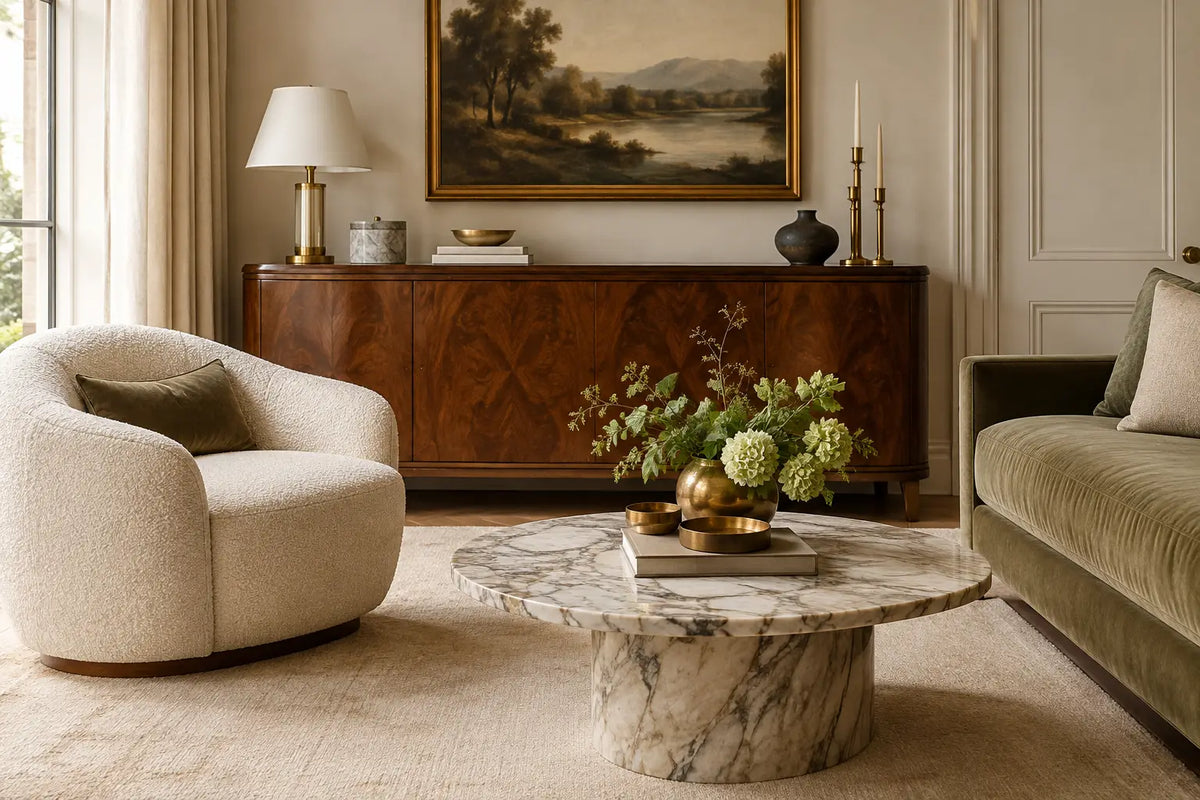
A dining table that gathers a family for decades develops a presence no newly purchased object can imitate. Its surface records celebrations, working lunches and the gentle patina of use; its value lies partly in that lived history. An heirloom furniture investment begins with this long view: choosing pieces that can be used fully, repaired intelligently and handed on with their integrity intact.
This is not simply a question of buying the most expensive item in a room. A costly piece can still be poorly proportioned, unsuited to its setting or difficult to maintain. The most enduring choices combine skilled construction, honest materials and a design language with enough restraint to remain persuasive as a home and its occupants evolve.
What Defines an Heirloom Furniture Investment?
Heirloom furniture is made with an expectation of permanence. That expectation affects every decision, from timber selection and joinery to the way upholstery can be renewed and a finish restored. It also requires a certain generosity of design. A piece should perform its original purpose exceptionally well, rather than asking its owner to preserve it as an untouchable artefact.
The distinction between longevity and collectability matters. Some furniture becomes valuable because of a celebrated maker, provenance or rarity. Those qualities may support resale value, but they are not the sole measure of an heirloom. A beautifully made bespoke console, designed precisely for an entrance hall and finished in a material that improves with age, may become profoundly significant to a family despite having no auction history.
For private homes, the strongest investments usually sit at the meeting point of emotional and practical value. A cabinet that accommodates changing collections, a sofa with a frame worthy of reupholstery, or a dining table with extension leaves can remain relevant through many chapters of domestic life.
Begin With Construction, Not Surface Appeal
Fine materials are essential, but materials alone do not guarantee a long life. The way components are joined determines how a piece responds to weight, movement and changing humidity.
In timber furniture, look for considered joinery appropriate to the form: mortise-and-tenon joints for chairs and tables, dovetails in drawers, and properly engineered corner blocks in cabinet work. Solid timber is often desirable, particularly in areas likely to receive wear, yet it must be properly seasoned and allowed to move naturally. A wide solid-wood top rigidly fixed to its base can split as seasons change; good craftsmanship accommodates this movement.
Quality veneers deserve a more nuanced assessment than their reputation sometimes receives. A carefully selected veneer allows rare figured woods to be used responsibly and can create exquisite pattern and symmetry across a surface. It should be laid over a stable substrate, with cleanly resolved edges and enough substance to withstand future conservation work. What matters is not a simplistic solid-versus-veneered verdict, but integrity of specification and execution.
For seating, ask what lies beneath the upholstery. A hardwood frame, durable webbing or springs, and cushions designed to be replenished will outlast fashionable silhouettes filled with materials that quickly lose their shape. Removable covers are useful in family settings, but not every tailored sofa benefits aesthetically from them. In those cases, selecting a fabric with appropriate abrasion resistance, colour fastness and cleanability is the wiser route.
Choose Materials That Gain Character
The finest heirloom pieces do not remain frozen in their showroom condition. They mature. Walnut deepens, brass develops a softer tone, natural stone acquires minute evidence of use, and vegetable-tanned leather becomes increasingly individual. These changes should be anticipated, not treated as defects.
There are practical limits. Highly porous pale stone can be unsuitable for a heavily used kitchen or a house where acidic spills are likely; it may need sealing and attentive care. A delicate lacquer can be magnificent on a formal cabinet but less convincing on a family dining table. Similarly, untreated steel introduces an industrial character and may oxidise in coastal or humid environments. Material selection should reflect the room’s real habits, not only its visual ambition.
Natural materials are not automatically superior in every application. Engineered stone, specialist lacquers and high-performance textiles can offer excellent durability where the brief demands it. The key is to understand their ageing behaviour and repair options. A surface that cannot be locally restored may be less suitable for a piece expected to remain in regular use for fifty years.
Proportion Is a Form of Longevity
Furniture can be impeccably made and still fail to endure if it is poorly scaled. Oversized seating that dominates a room, a table that restricts circulation, or a bed that leaves no visual breathing space will eventually feel burdensome. Long-term satisfaction often comes from proportion before ornament.
This is where spatial planning earns its place in a furnishing decision. Consider clearance around dining chairs, sightlines through an open-plan room, access for delivery and future moves, and how the piece relates to architecture rather than a temporary decorative scheme. Bespoke dimensions can be particularly valuable in period properties, penthouses and villas with unusual proportions, allowing the furniture to feel integral rather than imposed.
Timelessness should not be mistaken for neutrality. A sculptural chair, richly figured sideboard or expressive chandelier can become an heirloom if its quality is matched by a clear point of view. The question is not whether a piece is quiet, but whether it has a design rationale that will outlast a passing motif.
Balancing Sentiment, Use and Resale
It is sensible to be clear about what “investment” means. Most furniture should not be bought on the assumption that it will produce a financial return. The secondary market is selective, and tastes, condition, provenance and location all influence demand. Made-to-measure pieces can be especially difficult to resell, even when their craftsmanship is exceptional.
Their value may instead be expressed in decades of service, reduced replacement, the ability to repair rather than discard, and the pleasure of living with something that becomes familiar in the best sense. Collectible design pieces, documented commissions and works from established makers may hold value more reliably, but a purchase made solely for resale can lead to a home that feels curatorial rather than personal.
Keep records from the outset. Save invoices, specifications, fabric references, care guidance and any maker documentation. For bespoke commissions, drawings and photographs of the making process add useful provenance. This information supports future restoration, insurance and, if appropriate, a later sale.
Designing for Future Repair
A genuine heirloom should not be precious in the fragile sense. It should be maintainable. Before commissioning or purchasing, ask direct questions: can the upholstery be replaced without compromising the frame? Can a damaged stone top be refinished? Is the hardware from a source likely to remain available? Can the maker supply a matching finish after several years?
Furniture that separates into manageable elements can also have a longer practical life. A dining table with a replaceable top, a sectional sofa with individually recoverable modules, or cabinetry with adjustable internal fittings can adapt without losing its essential character. This is thoughtful design, not compromise.
Care should be proportionate. Use coasters and felt protection where sensible, avoid placing timber beside intense heat sources, and address spills promptly rather than aggressively. Professional restoration is often preferable to improvised repair, especially for veneers, polished metalwork, leather and specialist finishes. Patina is desirable; accumulated neglect is not.
A Considered Buying Framework
Before committing to a significant piece, assess it through four connected lenses:
- Craftsmanship: inspect the frame, joints, edges, drawer action, stitching and underside, not only the visible face.
- Material behaviour: understand how the timber, stone, metal or textile will respond to light, wear, humidity and cleaning.
- Functional fit: confirm dimensions, circulation, comfort, storage requirements and the realities of daily use.
- Future stewardship: establish maintenance needs, repair routes, lead times for replacement components and documentary provenance.
At Touched Interiors, this thinking informs the selection and specification process: furniture is considered within the architecture, routine and future life of the home, rather than as an isolated purchase. The result should feel settled from the beginning, yet capable of acquiring greater meaning over time.
The most worthwhile pieces are chosen with enough confidence to use them. Select furniture that welcomes the marks of a well-lived home, can be cared for by skilled hands, and will still have something generous to offer to those who inherit it.
Touched Interiors
The Insider is written by the Touched Interiors design studio in Manchester, founded by Kunal Trehan in 2009 and named Interior Design Studio of the Year in 2024 and 2025. About the studio.